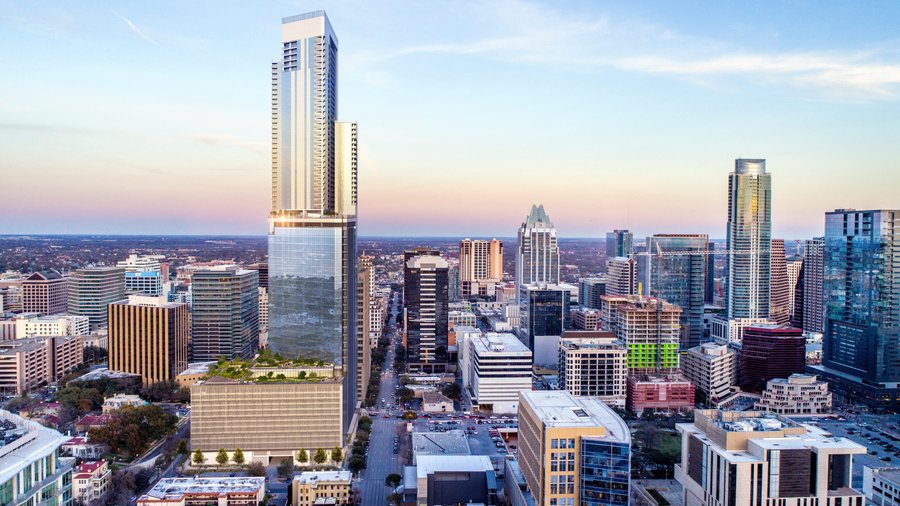
Stand at Sixth and Guadalupe and look up. The tower there was supposed to be Meta’s, 589,000 square feet of it, the biggest office lease in Austin history when it was signed. Meta never moved in. The company put the space up for sublease before a single employee badged through the doors, part of a retreat from nearly a million square feet of Austin office space.
That tower has become the stock image for a genre of story you’ve probably read a few times by now: Austin is over. The pandemic movers went home. The podcast bros found Miami, then found Nashville. Oracle, which arrived from the Bay Area in 2020 to great fanfare, moved its headquarters again… to Tennessee, and this year began cutting thousands of jobs, declining to say how many of them are here. Dell, the region’s original tech anchor, has shrunk from 133,000 employees to roughly 108,000 over two years of restructuring. Big-tech employment in the metro actually fell in 2024, down 1.6 percent. Downtown office vacancy sits at 20.6 percent, per the Downtown Austin Alliance’s latest State of Downtown report, and by some national surveys Austin’s overall office vacancy is the worst of America’s 25 largest metros.
So: dead, right?
Here is the number that doesn’t fit. In 2025, the same year the obituaries were running, startups headquartered in Austin raised $7.19 billion in venture funding, according to Crunchbase data. That is not a decent year. It is the best year in the city’s history, up 64.8 percent from 2024 and ahead of even 2021, when money was free and half of Twitter was posting moving-truck photos with Texas flags.
Both of these things are true at once. Austin’s tech economy didn’t die. It molted.
What actually left
Be precise about what the exodus was. The 2020-2022 wave brought two different populations to Austin, and they get conflated constantly.
The first was remote software workers and their employers’ satellite offices, people whose jobs were fundamentally located in San Francisco or Seattle and who were physically located wherever they wanted to be for a while. When the return-to-office mandates came down, that population went back. Business Insider was writing about tech workers who “regretted” the move as early as 2023. Elon Musk, who moved Tesla’s headquarters here in 2021, quietly moved its engineering headquarters back to California in 2023. This is the layer that peeled off, and its departure was always going to be loud, because these were the loudest people.
The second population was harder to see and didn’t leave: the operators, technical founders, and investors who relocated their whole lives. Silverton Partners managing partner Morgan Flager, talking to Crunchbase News about the record 2025 numbers, called the surge “the payoff from decades of compounding”, waves of Bay Area relocations that brought technical and operational talent to critical mass, talent that eventually spun out to start new companies, which is the only flywheel that has ever mattered in a startup town.
Meanwhile the correction in the job market is real, and it has a shape. The metro’s big-tech headcount grew roughly 40 percent between 2018 and 2023; a giveback was arithmetic, not apocalypse. What’s happening now is a bifurcation. Generalist software engineers are oversupplied, the layoff notices hitting the Texas Workforce Commission from Oracle, Expedia and others land mostly on them. AI and machine-learning engineers, meanwhile, are so scarce that recruiters describe effective unemployment below one percent. Austin isn’t short on tech jobs. It’s short on the tech jobs the last decade trained people for.
What actually arrived
Look at where that $7.19 billion went and you can watch the city’s identity change in real time.
The biggest round of 2025 wasn’t a SaaS company. It was Base Power, a two-year-old residential energy provider, which raised $1 billion at a $4 billion valuation. Saronic, which builds autonomous warships, raised $600 million, also at $4 billion. Apptronik, the UT-spinout humanoid robotics company, has now stacked more than $935 million into a single Series A. NinjaOne, the endpoint-management firm, hit a $5 billion valuation. Colossal Biosciences — the dire wolf people — carries a $10 billion one.
Warships, robots, batteries, de-extinction. Notice what’s missing: the mid-market B2B software company that defined Austin’s last era. Roughly 38 percent of 2025’s capital went to just five deals, and the deal count actually fell year over year — fewer, bigger, weirder bets, concentrated in companies that need land, power, and manufacturing labor as much as they need programmers. As Live Oak Ventures’ Krishna Srinivasan put it to Crunchbase News, these companies need “technology, land for manufacturing facilities, and talent for manufacturing tasks,” and Central Texas has an unusual density of all three.
The hardware turn extends past venture money. In Taylor, thirty minutes northeast, Samsung’s fab is coming online this year and is now slated to produce Tesla’s AI5 chip on a 2-nanometer process, part of a supply deal Musk has valued at $16.5 billion running into 2033, with about 1,500 permanent jobs expected at the site by year’s end. And in March, Musk announced plans for “Terafab,” a pair of semiconductor plants in the Austin area that he claims will total 100 million square feet, an initiative outlets have pegged near $25 billion. Discount Musk announcements as heavily as experience suggests you should; even the discounted version is not what disinvestment looks like.
The money men are voting with their leases, too. Craft Ventures, the San Francisco firm co-founded by David Sacks, signed an Austin office lease in December, and Sacks moved here himself. Barcelona’s Biorce chose Austin for its U.S. R&D hub this spring, its CEO citing one reason above all: talent.
The tower and the ledger
None of this pays the mortgage on an empty office tower, and nobody should pretend it does. Downtown’s 20.6 percent vacancy is a real wound, inflicted by a specific bet, that Austin’s future was thousands of badge-swiping employees of California companies, that the city’s landlords lost. It will take years to work through, though the Downtown Austin Alliance notes vacancy has finally started falling, and the street level tells a different story than the office floors: 740 storefronts, $2.5 billion in annual consumer spending, two Michelin stars.
The honest answer to “is Austin tech dying” is that a particular Austin is gone and was always going to be. The city spent a decade as the cheap, fun annex of Silicon Valley, and that arrangement ended the way all arbitrage ends. What’s replaced it is smaller in headcount, vastly larger in capital, and bolted much more firmly to the ground, you cannot sublease a chip fab or take a robotics lab remote.
A city renting out its cool is a landlord, and landlords get vacated. A city that builds warships and de-extincts wolves is something else. The empty tower at Sixth and Guadalupe is a monument to the first Austin. The second one didn’t bother waiting for the funeral.